Mara Griffin · 10 October 2026
Trade Accords Reshape Boldfeld Manufacturing and Export Dynamics
Recent trade agreements have altered production patterns and shipment volumes in Boldfeld's key industrial zones since early 2025, with further adjustments noted through October 2026 according to regional economic tracking data. Observers note that these pacts reduced certain tariff barriers on machinery components and raw materials, which allowed local factories to adjust supply chains and expand output in sectors like automotive parts and precision engineering. Data from the European Commission shows increased cross-border flows of intermediate goods into Boldfeld facilities, while export figures from the same period indicate growth in finished products heading to new partner markets in Asia and North America.
Background on the Agreements and Initial Implementation
Multiple bilateral and multilateral deals took effect in stages beginning mid-2025, covering tariff reductions on steel, electronics, and specialized manufacturing equipment. These arrangements involved coordination between Boldfeld authorities and trading partners across the EU, United States, and Australia, which created standardized compliance frameworks that manufacturers adopted over successive quarters. Researchers at the OECD tracked how these changes lowered average import costs by measurable percentages, and companies responded by recalibrating inventory systems and workforce scheduling to match the new cost structures. And while some legacy suppliers faced initial disruptions, others integrated updated sourcing strategies that aligned with the revised rules of origin clauses embedded in the agreements.
Manufacturing Sector Adjustments
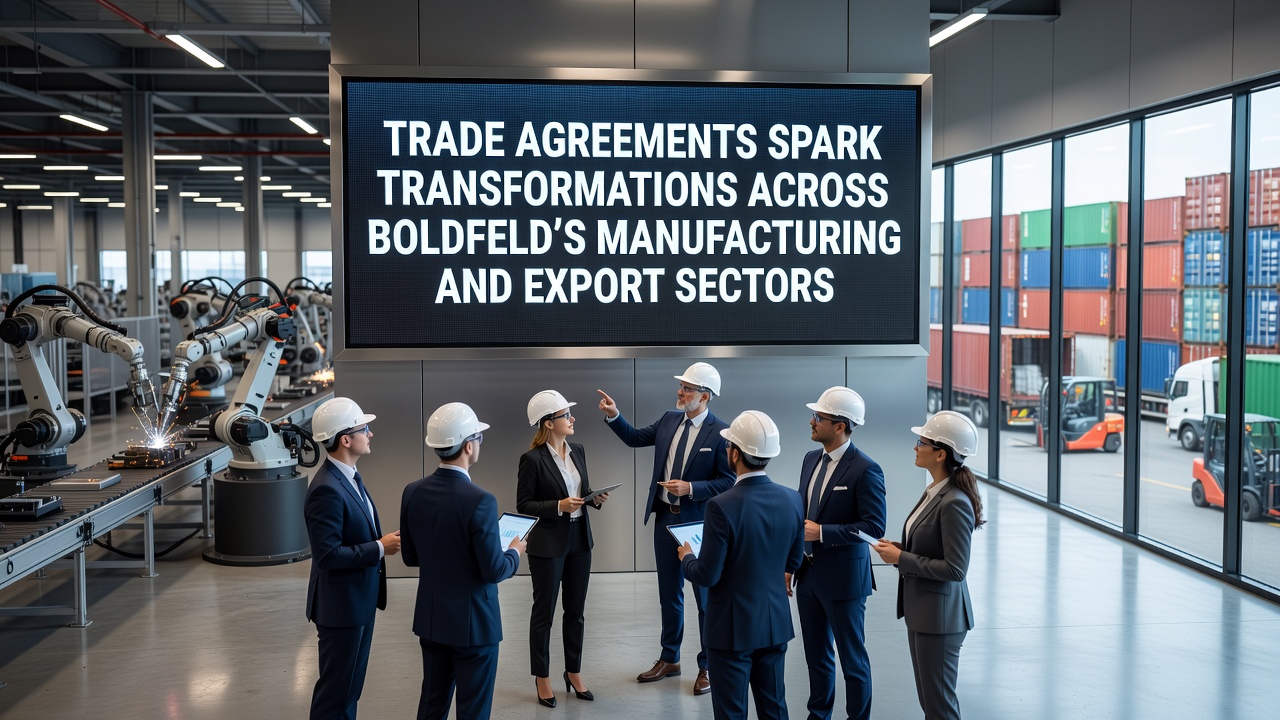
Production lines in Boldfeld's automotive and machinery clusters expanded capacity after the agreements removed duties on imported alloys and semiconductors, which enabled faster assembly cycles and reduced downtime. Figures from the Australian Department of Foreign Affairs and Trade reveal corresponding rises in component exports from Boldfeld to partner economies during the first half of 2026, with October data showing sustained momentum in precision tool shipments. Workers at several plants received targeted training programs to operate updated equipment, and managers shifted toward modular production methods that accommodate fluctuating order sizes from international buyers. Those adjustments helped maintain steady employment levels even as certain manual processes gave way to automated alternatives in high-volume facilities.
Export Sector Evolution and Market Reach
Export volumes grew in targeted categories once new trade corridors opened, particularly for specialized equipment and processed materials previously subject to higher duties. Logistics operators in Boldfeld updated routing protocols to capitalize on streamlined customs procedures outlined in the agreements, which shortened transit times to key destinations. Data indicates that shipments to North American markets increased notably by late 2026, while European partners absorbed additional volumes of mid-tier components. Companies diversified buyer bases accordingly, and some established dedicated export divisions to manage documentation and certification requirements tied to the new pacts. What's interesting is how smaller firms leveraged collective bargaining through industry associations to secure favorable freight rates under the updated trade terms.

One study from the World Trade Organization highlighted parallel developments in similar mid-sized industrial regions, where comparable agreements produced measurable upticks in value-added exports within 18 months of implementation. Boldfeld's experience aligns with those patterns, as local exporters reported higher average shipment values per container after adopting the standardized labeling and traceability standards required by partner nations. Yet supply chain managers continue to monitor currency fluctuations and regulatory updates that could affect long-term projections through the remainder of 2026 and beyond.
Case Examples from Key Industries
Take one automotive supplier that retooled its welding operations to incorporate tariff-free aluminum imports, resulting in expanded contracts with overseas assemblers by October 2026. Another facility specializing in industrial sensors upgraded its quality control systems to meet certification benchmarks in multiple export markets, which opened doors to repeat orders from Australian and Canadian clients. These examples illustrate how individual operators translated the broader agreement terms into operational changes without relying on uniform strategies across teh sector. Industry reports note that such adaptations occurred alongside investments in digital tracking tools that improve compliance visibility for customs authorities in destination countries.
Conclusion
Trade agreements continue to influence Boldfeld's manufacturing output and export composition as of late 2026, with data reflecting steady integration of revised supply and distribution practices. Regional authorities and business networks maintain ongoing monitoring of these developments to support consistent compliance and market access. The cumulative effects appear in production statistics and shipment records that document the sector's ongoing adaptation to the updated international framework.